Devan Egan, co-founder and owner of Club Pickleball USA in Utah, is one of the earliest private indoor club operators in the sport. With three facilities open and a fourth on the way, he has helped shape what sustainable pickleball business models look like in a highly competitive market. Beyond his own clubs, Devan leads a mastermind program of more than 150 pickleball club owners across the country, where he facilitates collaboration and best practices. In this Q&A with Pickleball Club Magazine at PickleCon, he shares insights on profitability, programming, technology, and sponsorships, all centered around building a model that works in both the short and long term.
Pickleball Club Magazine: We have Devan Egan from Club Pickleball, USA. We’re going to ask him some questions. Devin, would you mind just telling us about your club and what you do?
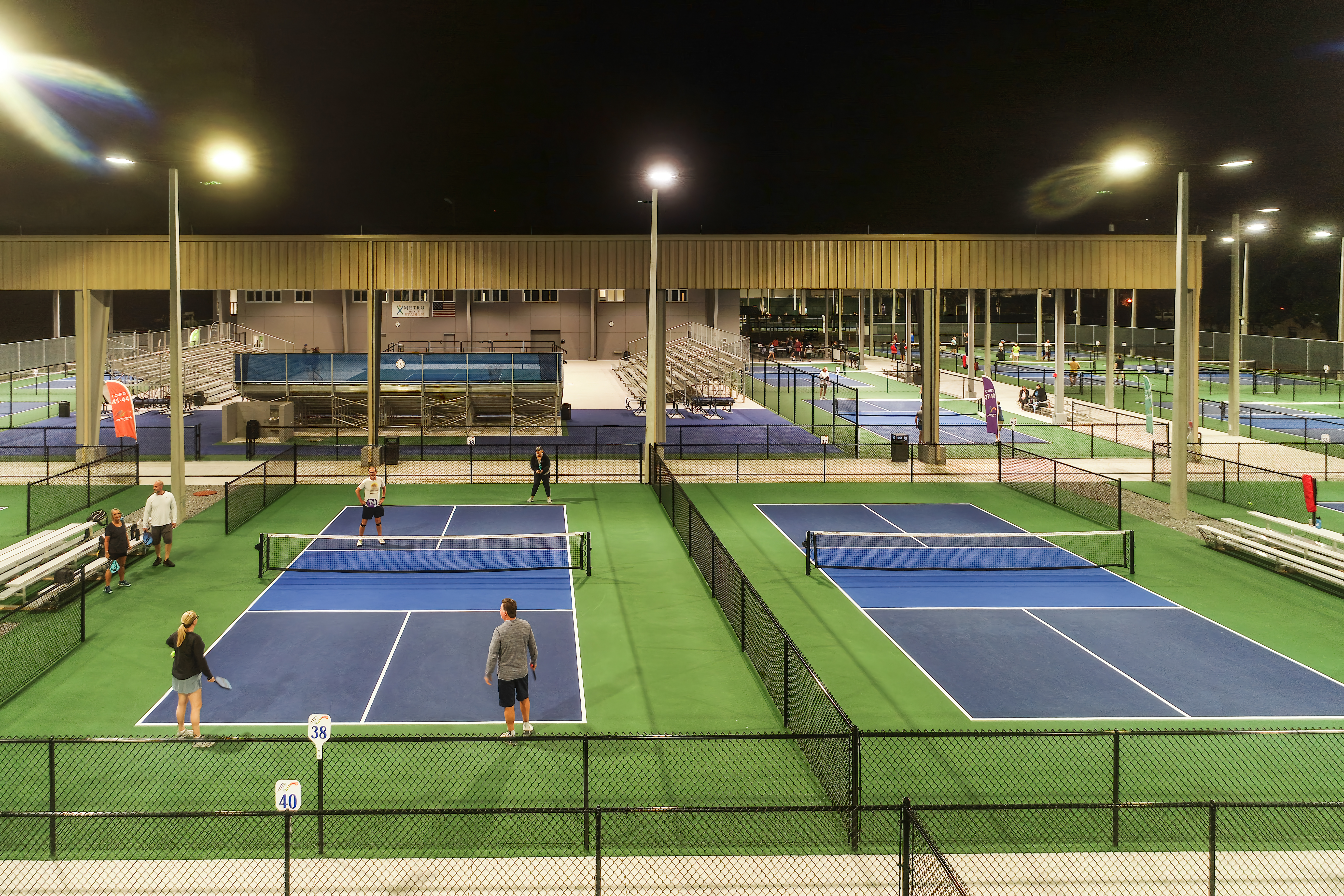
Devan Egan: So if you haven’t heard of us, it’s because we’re not a franchise. We’re Club Pickleball USA out of Utah. We’ve got three locations and just signed yesterday for our fourth. That’s 35 indoor courts spread across a 15-court facility, a 14-court facility, and a little pilot facility with six courts. The next one will be nine courts.
We’ve been in the game for five years, so as young as pickleball is, I’m a bit of a dinosaur in the industry just by getting started early. Many of you are close friends of mine. I run a mastermind group for pickleball club owners, and we’ve got 150 clubs that are part of this private network where we share best practices and help each other out.
My dad is my business partner, but he’s now retired in Argentina with my mom, doing mission work and enjoying life. I still get to run the business today.
PCM: Alright, we’ll start with an easy one here. What are the key factors that contribute to profitability, and how can owners prioritize those factors?
DE: I think the biggest mistake people make with profitability is focusing too much on incoming revenue. In reality, profitability is largely tied to outgoing revenue.
How well are you managing expenses? Did you negotiate your lease aggressively enough? Too often, new operators get excited about securing a building and don’t think about what happens six months down the road when the weather turns and that lease suddenly feels a lot heavier.
I’ve seen nearby clubs close within three months of opening because they overburdened themselves, promising six-figure salaries and taking on payroll they couldn’t sustain. That’s why I always start with expenses. In my own organization, five years in with three facilities, an area manager, and a head pro who was PPR’s Pro of the Year, we don’t pay anyone a salary. All of our staff are part-time. Running lean is critical to staying profitable.
Once you have expenses under control, then you can focus on building revenue,but you need the right model. One of the biggest mistakes clubs make is tying their entire business model to one revenue stream, usually memberships. They look at their expense sheet: lease, payroll, insurance, utilities, maintenance, and immediately think memberships will cover it. That’s a dangerous approach, because you won’t sell memberships unless you’re a really strong marketer who can drive traffic through the door.
Your first goal should be utilization. Before I ever think about memberships, I ask: Can I break even just on occupancy? At Club Pickleball USA, memberships are profitable. Break-even comes from people on courts, whether they’re members or not. That mindset changes everything.
So when you’re building your model, start by asking: with X number of courts, Y expenses, and Z hours of operation, what average dollar per court hour do I need to generate at a reasonable occupancy rate, say 40 percent, to break even? If you nail that math, everything else falls into place. You’ll optimize programming, you’ll focus on the player experience, and you won’t care whether someone’s a member or a drop-in because everyone walking through the door is valuable.
Eventually, memberships sell themselves, not because you need them to stay afloat, but because the experience is so good that people want to commit. Profitability stems from building the right model up front, managing expenses with discipline, and never tying your revenue to a single source.
PCM: A follow-up for you. You mentioned player experience and whether they’re a member or not coming through the door. They get that experience. So, how are you correlating that experience and profitability? You know, how do those two things mesh in your mind?
DE: So, I would put it this way: when you think about profitability, it’s dollars and cents, but behind every dollar and cent are people and how they feel when they come into your business. If you treat a visitor like just a visitor, the odds of them coming back are slim. But if you treat everyone as if they’re either a member or a highly probable future member, the culture of your club changes. You create a sticky environment that people want to return to, an experience they want again.
This element of visitor versus member is important. I like to give everyone a reasonable rate that doesn’t disenfranchise the majority of people in the marketplace. This ties back to the business model, and I know some disagree with me on this, which is fine, but my view is that if your club runs on an “all-inclusive membership” where everything is free, then in order to manufacture value in that membership, you often end up raising visitor rates to the point where they sting. That’s how you justify the membership price.
In the model I run, I don’t have to do that. My rates are reasonable and fair to visitors. For example, one of our local competitors switched to an all-inclusive model, and after that, we actually saw our visitor revenue increase. Why? Because at their place, a single visit might cost $25 or $30. At Club Pickleball, visitors know they aren’t being overcharged just because they’re not members.
So, one of the keys to profitability is casting a wide net where everyone feels they can participate at your club without sticker shock. If someone calls and says, “Hey, we’re just in town for a day,” or “We don’t play that often, but the weather’s bad, what’s the rate?” and the answer is $120 for four people, that’s a turnoff. But if the answer is $40, or whatever the fair market rate is, they’ll say yes.
Ultimately, you want a model that makes sense for every frequency of play. If someone plays once a year, the price feels fair. If they play once a month, it feels fair. If they play every day, it still feels fair.

PCM: I think you may have touched on it a little bit before, but what are some common pitfalls that people make financially when they’re getting into a pickleball club?
DE: I mentioned a few of them already. The common pitfalls are paying too much for a lease or building, overburdening yourself with debt, bringing on too many partners, and ending up with too many decision makers.
Other critical pitfalls come from not being really thoughtful about your model. For example, I met with a club before my last mastermind in June. They showed me their spreadsheet and said, “We think we’re onto something; it’s only going to take us about 10 months to break even.” I said, “Ten months? Who wants to operate at a loss for 10 months?” Their plan was basically to rely on building up memberships over time to cover expenses. That’s a broken model.
When I asked what they were charging for open play, organized events, court reservations, and usage fees, they said everything was baked into the membership. I showed them an alternative structure that could get them to break even much faster. The issue was that their entire model depended on a membership ramp that was way too long.
On the flip side, I’ll meet with clubs using a pay-to-play model, but their pricing is inconsistent. For example, the difference between a visitor and a member for open play might be $5, but for an organized skill event, it’s $10, and for college night, it’s $12. Then their membership price is $700. Players do the math and say, “At $7 extra per play, I’d have to come here a hundred times just to break even.” That’s why they aren’t selling memberships.
At Club Pickleball USA, our model is consistent. For open play, a visitor pays $10 more than a member. For an organized skill event, $10 more. For a court reservation, $10 more. That consistency makes it easy for players to understand, and easy for staff to sell. If someone plays once a week, that’s $520 more per year as a visitor. Our entry-level membership is $497 plus tax, almost exactly the same. No complicated math, no confusion.
The pitfall, then, is rolling out pricing that hasn’t been thought through. Without balanced and consistent pricing, some players will find value in a membership, but many won’t.
PCM: What are some other ways that clubs can be profitable?
DE: Yeah, I like to categorize revenue types. Let’s say it’s August, the weather’s nice, and your club isn’t making the money you need it to make. What’s the solution? I go into my “I need cash right now” bucket.
If you’ve never been in that situation, it’s either really good news because your club is crushing it, or you just haven’t run into the challenge of competing with outdoor play when the weather turns nice.
For quick cash strategies, I like membership drives and corporate events. On memberships, I never discount the price. I’m not talking about showing desperation and chopping $100 off. That just devalues your offer. Instead, I focus on loading up value and giving players more reasons to buy right now.
Corporate events are another great quick-cash strategy. We run ad campaigns with messaging like: “Your corporate events are boring, expensive, and nobody likes them, we can fix that. Pickleball is the fastest-growing sport in America, and your employees, clients, and contractors will love it. Plus, it’s cheaper than anything else you’ll do.” My cost per lead is typically between $75 and $350, but my average event is just under $4,000, and my VP of Sales closes 70–80% of qualified leads. That’s an exchange I’ll make all day.
Tournaments are another lever. We run one every month, usually generating $12–15K in gross revenue. If it’s the 10th of the month and I see we’re not on track, I’ll hop into Canva, design a quick tournament flyer, plug it into the calendar, and launch marketing with an “early bird” rate. My rule of thumb: the regular rate is actually the discounted rate, and prices only go up as the date approaches. That way, I can bank $8–10K in five days and smooth out cash flow.
Those are quick-cash plays. For consistent, predictable revenue, I focus on annual memberships and programming. I don’t do monthly memberships; I despise them. We’re annual only, in a very competitive Utah market where almost everyone else is monthly. Why? Predictability. If you can’t sell an annual membership, your offer isn’t compelling enough. Stack enough value, and people will happily commit for a year. That way, before September even begins, I know that about 93% of my members scheduled to renew that month will do so like clockwork.
Finally, programming revenue is essential. Almost nothing at Club Pickleball USA is free, except for off-peak open plays from 5-8 AM, 1-4 PM, and 9-midnight. Otherwise, every player is paying to play. And with great programming: round robins, leagues, challenge courts, and events for every skill level, utilization stays strong and revenue stays steady.
PCM: How can technology contribute to profitability?
DE: It reduces friction for the player and encourages frequency of play. In just three clicks, they can register for an event without calling or talking to anyone, then show up to a 32-player 3.5 round robin and know everything is ready.
Technology can’t be overstated. We live in a world of tech, and we’re using AI almost daily, certainly weekly, for ad copy, video messaging, and content we push out on social. Technology makes you far more efficient, reduces expenses, and protects you from weaknesses in your business. The tracking and reporting we get from CourtReserve, for example, lets us monitor the key factors driving our revenue, all in one system.
One area I didn’t mention earlier on revenue is sponsorships. Sponsorships are essentially pure profit. When you think about margins, outside of the cost of a banner or the labor to enter a sponsor’s name into CourtReserve, it’s some of the highest-margin revenue you can generate. Sponsorships are a highly underutilized opportunity for clubs and well worth exploring.
PCM: Can you give us some examples of where you sell those sponsorships?
DE: We recently did a deal with the Utah Jazz, and at first you might think, “What do the Utah Jazz want with a pickleball club?” The reality is the Jazz sell sponsorships for both the basketball team and the Utah Hockey Club, and they use pickleball as a recruiting mechanism. Pickleball is far less intimidating than golf. People don’t need clubs; it’s easy to learn, and no one feels embarrassed if they’re not great at it. That made it the perfect fit.
The sponsorship was largely about hospitality, giving them corporate experiences in the club and special access to certain courts at certain times. Sponsorship revenue can be powerful if you structure it right. The key is to categorize your offerings:
- Hospitality: corporate events, executive-level memberships, special access, on-court experiences.
- Media: placements in your facility, digital channels like Instagram, email lists, tournament branding, and more.
Once you have inventoried everything you can sell, you can package it. Too many clubs stop at selling a single banner for $1,000 or $1,800 a year. Instead, bundle it: podium signage, quarterly emails, social collaborations, tournament sponsorships, all in one package. That way, you’re meeting the sponsor’s goals while creating much more value.
When we work with sponsors, we always start with a discovery session: What are your goals? What’s your budget? From there, we build three proposals: at budget, just above budget, and well above budget. That way, they have options. With the Jazz, they chose the “just above budget” package, which worked well for both sides.
Another quick tip: not every sponsor is ready to spend $15,000–$30,000 right away. We like to give them a proof of concept. For example, we worked with Prime IV. Their ideal customers are active, fitness-minded people, a perfect overlap with pickleball players, but they weren’t ready to commit to a full sponsorship. So we offered them a tournament sponsorship for $1,000. They set up a booth, provided IVs in our party room, and interacted with players all weekend. That experience converted them into a $15,000 sponsor, with permanent placement in our Sandy club and on CourtReserve.
The takeaway: give sponsors a chance to engage directly with your players. Don’t do it for free, but offer an entry-level opportunity that can roll into a larger package once they see the value.
PCM: We are out of time. That was really good. Thank you, Devan.