Pictona, a world-class pickleball complex located in Daytona Beach, Florida, is creating waves at the “World’s Most Famous Beach”. In this interview, we sit down with Mark Shaw of Pictona to hear about the journey of this club’s founders, Rainer and Julie Martens, and how their love for the sport evolved into a multi-million-dollar facility. From its origins as an idea to alleviate crowded courts, Pictona has grown into a 15-acre campus with 49 courts, a 1,200-seat stadium, and various recreational amenities. Shaw shares insights into the Martens’ dedication, the challenges and triumphs of developing Pictona, and the unique position it holds within the Daytona Beach area as a top-tier pickleball venue that attracts both local members and global visitors.
Pickleball Club Magazine: First off, tell me a little about how the founders of Pictona got started in the world of pickleball.
Mark Shaw: Rainer and Julie Martens are the cofounders of Pictona. Julie discovered pickleball at the Daytona Beach Shores courts in 2011. Julie had played most other racquet sports, but when she came home after her first introduction to pickleball she raved about how much fun it was. Rainer began playing pickleball in 2016 after retiring from a successful career in slow-pitch softball.
PCM: How did this lead to the creation of Pictona?
MS: By 2017 the courts at the “Shores” were very busy, with long waits between games to play. Rainer, Julie, and Chuck Mecklem began the search for space to build more courts. The City of Daytona Beach chose not to respond to the Martens’ proposal to build 16 courts at a city-owned tennis center that was losing money. Chuck knew the mayor of Holly Hill, the small city nestled between Daytona Beach and Ormond Beach. Rainer and Julie met with mayor John Penny and City Manager Joe Forte, and they were receptive to having courts built at the park across the street from the city offices. Not only were they receptive, but they were also encouraging.

Just one stipulation: The City didn’t have the money so we would have to find the financing. Fundraising would take years and we wanted courts soon. The Martens had just sold a restaurant and hotel in St. Augustine and thus proposed to the City that they would provide $3 million if the City would provide $1 million and pay the utilities. The City Commission approved the project which consisted of 24 courts, 8 of which are covered, a 9000 square foot clubhouse with a restaurant called The Kitchen (of course), locker rooms, and a Player Shop. As might be expected, the project ended up costing $6.3 million rather than $4 million. The City contributed another $300,000 and the Martens covered the rest.
A note about the name Pictona: Rainer created Pictona from PICkleball + dayTONA. Julie didn’t think too much of the name at first, but after a short time she enthusiastically voted for it.
PCM: What inspired you to build one of the largest pickleball venues in the country?
MS: Membership exceeded our expectations of 300 players and quickly grew to 600 when we opened in July of 2020. We also began hosting tournaments, but when we did, we deprived our members from playing on the courts. Julie and Rainer were really pleased with the response to Pictona. Many members shared with them how the facility, especially through the Covid years, provided a place to safely exercise and socialize. With that encouragement Rainer and Julie decided to build 24 more courts along with a championship stadium that seats 1,200 and includes five covered courts and a two-story office/education building.
What is called Pictona 2, was funded by the City of Holly Hill donating $1 million, $2.5 million from a Volusia County ECHO grant (Environmental, Cultural, Historical, and Outdoor), and the remainder from the Martens. The initial budget for Pictona 2 was $4 million but quickly grew to $6 million as a second story was added to the building plans. Inflation was raging during the construction period and the final cost was $8.3 million, including furniture and fixtures. The total campus that sits on 15 acres ended up costing $14.6 million and Pictona 2 opened in October 2022. The City of Holly Hill owns the campus, and the Pictona Club is operated by the members as a not-for-profit 501.c.3 and is self-supporting through memberships, tournaments, events, and sponsorships.

PCM: What challenges did you face in building the venue?
MS: The construction of the facility proceeded mostly on time because we employed A.W. Weigel Construction company to manage both Pictona 1 and 2. The challenge with Pictona 1 was finding capable sub-contractors during the Covid period, and for Pictona 2 it was the outlandish increases in costs as well as finding materials and supplies. All of these were overcome by the construction management firm. Bi-weekly meetings amongst the architect, Weigel, City of Holly Hill, and the Martens kept the project on track.
PCM: If you had to do it over again, what would you do differently in building the venue?
MS: There is not enough space in this article to answer that question in detail. Nevertheless, the collective efforts of the planning/building team created an excellent facility that is totally dedicated to pickleball. The major change the Martens would have made had they known, would have been to design one clubhouse and one entry point to the facility rather than Pictona 1 and Pictona 2.
After the completion of Pictona 1 and 2, many small enhancements have been made based on how the facility is used by members and during tournaments. Artificial turf, re-designed gardens, more windscreens and shade covers, more bleachers, and an expanded player shop have all been added.

PCM: What are some things that make Pictona unique?
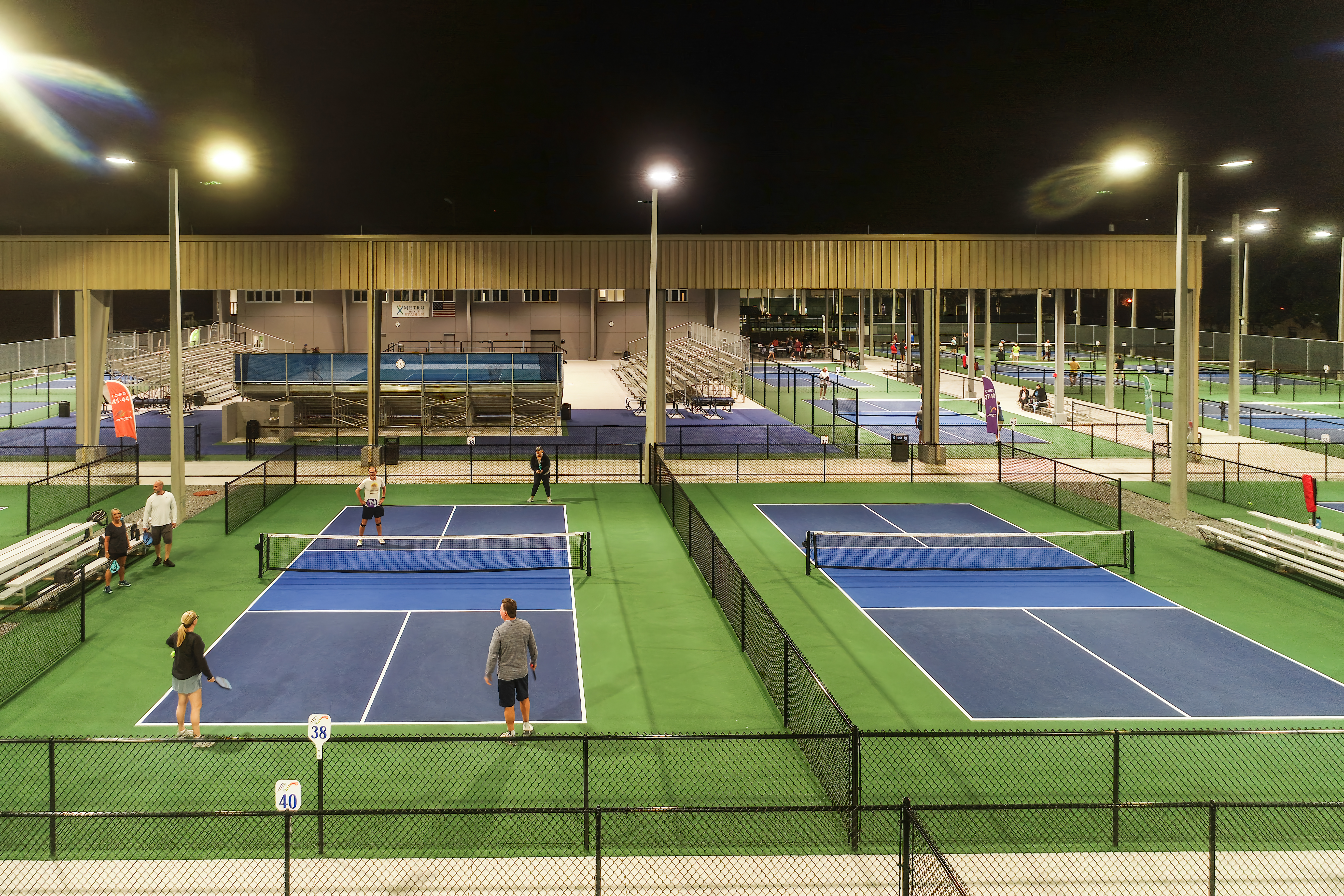
MS: 49 Courts! All of them are outside, but 13 of them are covered, so you can play in the middle of a summer rainstorm! Each court is individually fenced, which makes a great barrier for out of bound balls. We have a championship stadium that seats up to 1,200 spectators. When not being used for tournaments, the City of Holly Hill uses the stadium for concerts and events. We’re not just pickleball! We have a 9-hole putting green, cornhole, shuffleboard, and a state-of-the-art croquet court.
PCM: What types of programs, events, and classes do you currently offer?
MS: Pictona offers a variety of educational activities for players of all ages & skill sets. We have a robust education program with nine staff instructors. We also offer 3-Day Kids Camps in the summer and 3-Day Adult Camps in the winter months. In addition, we offer clinics with visiting pros, and we have our own Referee Training Academy. Never played pickleball? We offer FREE beginner lessons 5 days a week.
PCM: What are some of the unique challenges of running a pickleball club in a tourist town like Daytona?
MS: Pictona has about 1350 club members from residents in the greater Daytona area. The basic fee is $400 annually for an adult, or $40 monthly. In addition, perhaps because we are located in a tourism hub or perhaps because of the world class facility, Pictona has many visitors who purchase day passes for $15 per day.

Rainer and Julie Martens were not only the major contributors to the cost of the facility, they also volunteered to operate it from the day it opened in July 2020 until July 2024 when John Phillips was hired as the new CEO. The challenge of setting up and staffing the operations of Pictona were far more than what the Martens expected. Currently Pictona is operated by 13 full-time staff and 30 part-time employees.
PCM: What are some of the unique benefits of running a pickleball club in a tourist town like Daytona?
MS: The greater Daytona Beach area attracts more than 10 million visitors per year, so we have opportunities to have visitors from all over the world. In addition, we have attracted many well-known athletes to play at Pictona, including former tennis great Ivan Lendl and current NASCAR driver Austin Dillon.
PCM: What advice would you give to someone wanting to start a pickleball club?
MS: Rainer has had many people call and visit seeking to learn more about how to build a facility and how it operates. The biggest challenge is securing the funding and land in a good location. How one proceeds depends on whether the club will be for profit or not. Many public facilities are being built where access is free or very low which competes with facilities charging a fee and seeking a profit.
PCM: Is there anything else you’d like to add?
MS: Pictona’s evolution is unique because of the Martens’ philanthropy in building and operating the facility. Their underlying motivation was to promote physical activity and health through an engaging sport for all ages…and to have a place to play where they didn’t have to wait for a court. Pictona is a happy place for all!