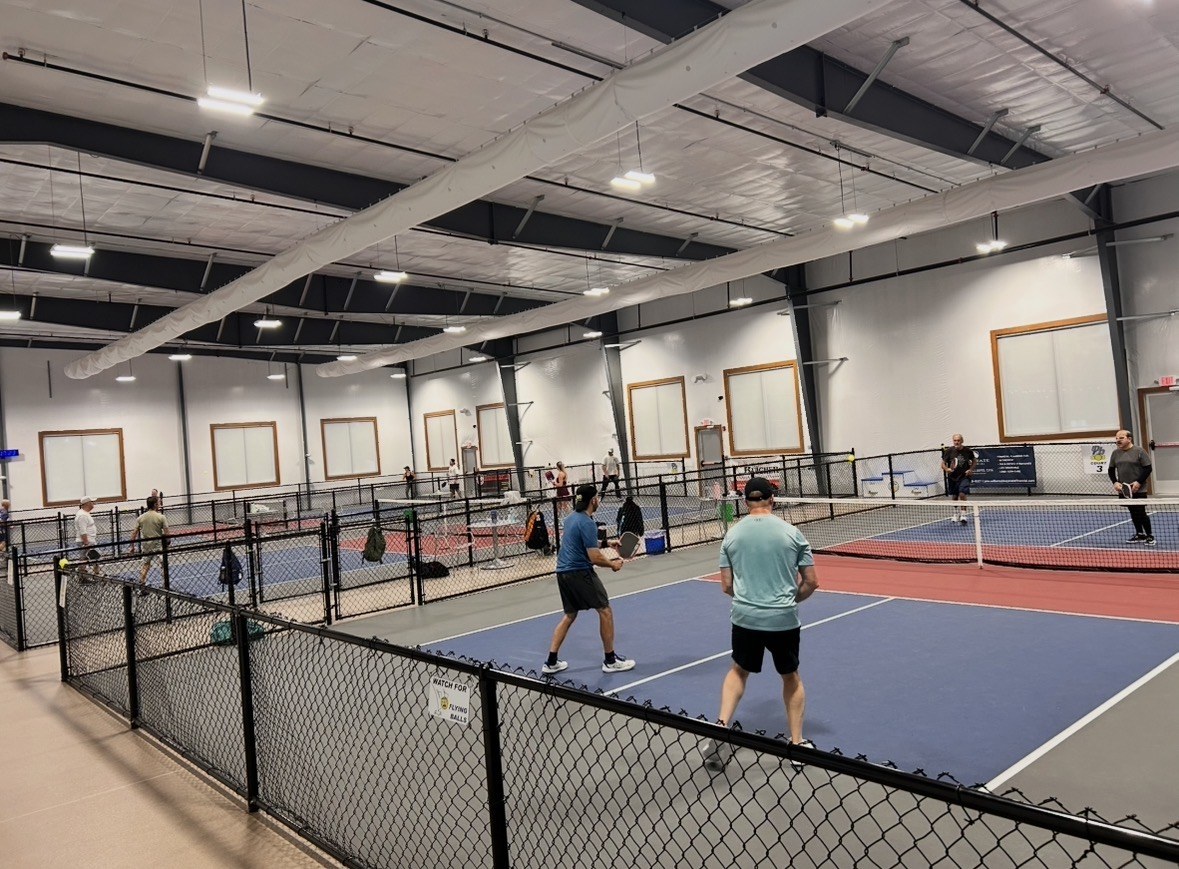
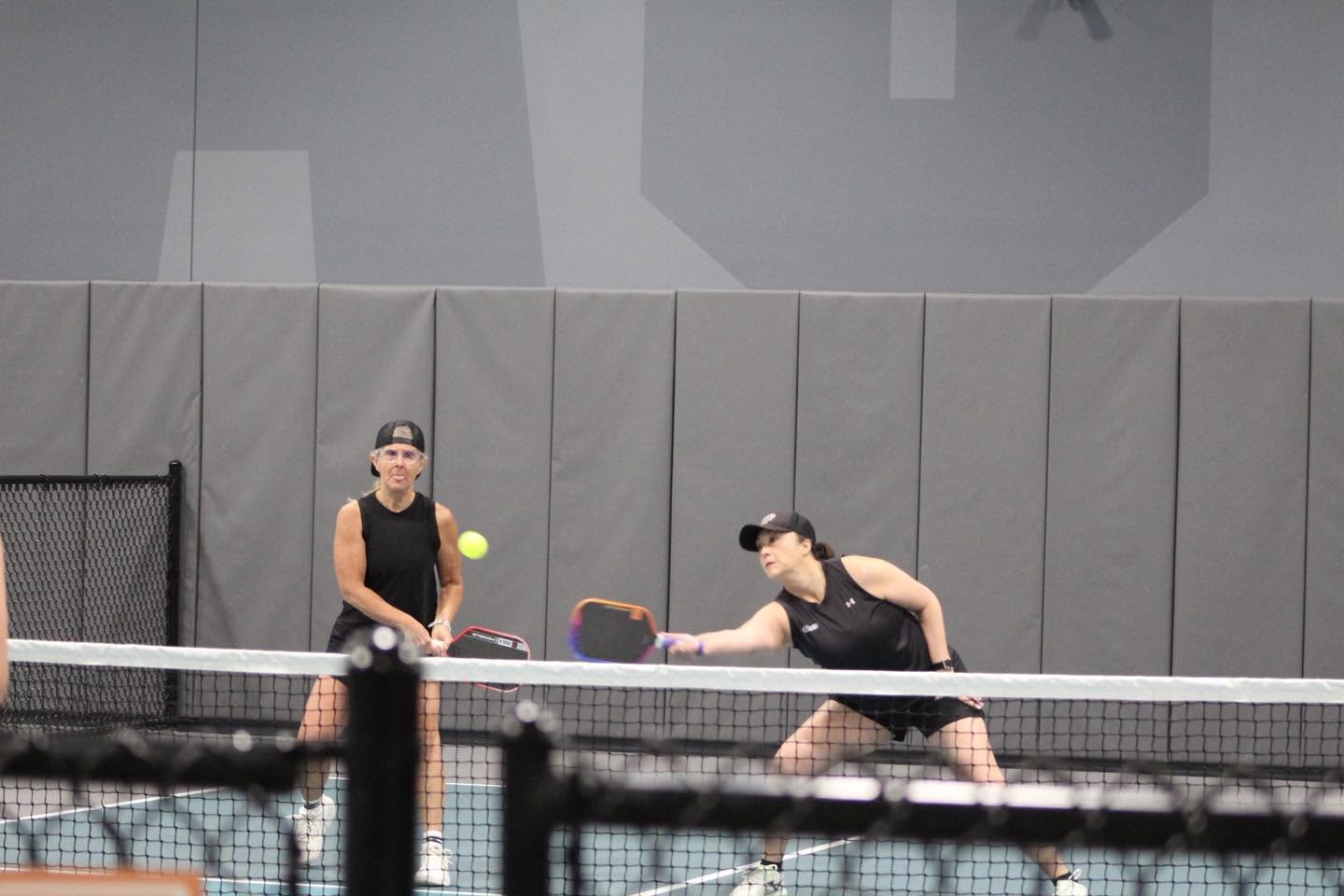
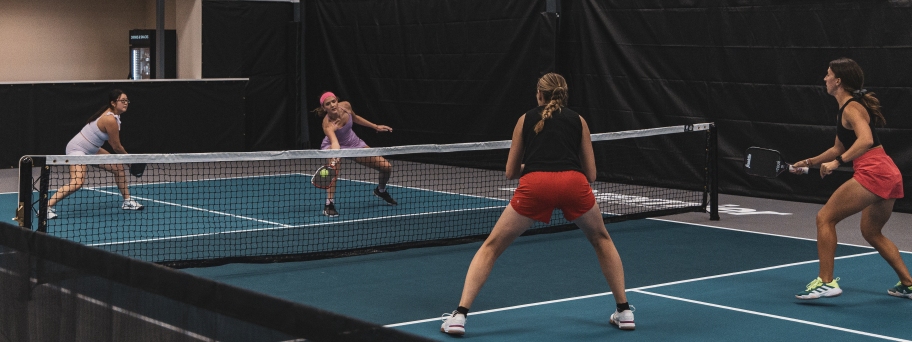
College pickleball has exploded over the past three years, and its explosion is a microcosm of the explosion of pickleball as a whole. The Indiana University Pickleball Club stands as an excellent example of the stirrings happening at the college level. Indiana University is a very large college with almost 50,000 undergraduates, yet three years ago, students wouldn’t have been able to find a club on campus. Fast forward to the present. IU Pickleball has hundreds of members, recreational and competitive play, and is currently ranked ninth overall on DUPR.
Before IU Pickleball began, college students who wanted to play would go to the public courts because there were no courts on campus. Sam Hutner, the current president of the club, saw the need for a college club. So he reached out to Timber Tucker for advice. Tucker was a member of the Bloomington Pickleball Club at the time. He went on to help advise and coach for IU Pickleball, and now he’s working as a consultant.
IU Pickleball began three years ago as an unofficial, recreational club, and droves of people began to show up: “The word just got out.” By the time the club became official last January, it was the biggest club sport on campus.
Tucker remarks that one of the advantages of starting a college club is that “you have a captive audience.” Depending on the size of the school, there may be thousands of students looking for a fun, accessible, and new sport to play.
IU’s club began as a recreational club geared more towards fun, community, and casual play. There was only one official competitive college tournament at the time, so there wasn’t much reason to focus on competition. But times changed, and now three college tours host their own regional, and college players from around the country can access multiple national-level competitions. Tucker estimates that together these three tours are hosting 27 different sanctioned events this fall.

Because of these developments, Hutner, Tucker, and others at IU started to look at adding a more competitive side to the club. Tucker recounts the transition: “We put together a quick team for a regional, won the regional, went to nationals, and had a ball. It was kind of a dream come true to be able to coach an Indiana team.”
Since that dream-like run, IU Pickleball has provided a competitive element alongside its more casual one. The competitive players have won national championships in women’s singles and in mixed doubles and have faced off against some of the best pros in the country like Jack Monroe and Jack Foster.
All club owners know that the competitive and casual elements, though entertaining, are not always easy to reconcile. Oftentimes conflicts of interest arise between the highly-skilled players and the players who just want something entertaining to do with their Saturday. To remedy this problem, IU Pickleball appointed a president and two vice presidents to oversee the club; one vice president focuses on the competitive events, and the other on the recreational. Besides playing in out-of-state competitive events, IU Pickleball hosts various ladder leagues, clinics, fundraisers, and structured open play sessions.
Tucker compares the overall structure of the club to a Premier League soccer team. Premier League soccer teams are the highest-level teams, but under them is a whole list of feeder organizations. Thanks to this structure, even the casual “Sunday league” player can feel a sense of camaraderie with their affiliate club. Tucker insists, “We want you to identify with the club even if you’re a very recreational player.”
Another benefit that came with IU’s new competitive side was its official status as a club sport which can be hard to come by at larger schools. Tucker says, “The bigger the school, the more valuable the brand.” Well-known colleges and universities have good reason to be protective of their brands: “Colleges don’t want a bunch of rogue students going out and sullying the name.” Thus, it can take a long time for a potential club to gain official status. The bureaucracies at larger universities also prolong the process: “The bigger the college, the more they love bureaucracy.” Dealing with bureaucracy usually requires a lot of communication, case-making, and especially waiting. Tucker warns that what seems like a one-week project often gets drawn out into a “six-month process.”

The developments mentioned above are not the only exciting things happening related to Indiana University Pickleball. Timber Tucker, their advisor and coach, along with Birch Dalton are working to provide a new resource that will foster communication and growth between new and existing college pickleball organizations—the Association of College Pickleball Clubs (ACPC).
Back near the beginning of IU Pickleball, Tucker and others wanted to start consulting aspiring college clubs. They soon realized that a consulting group wasn’t going to be “enough” because of the massive growth of college pickleball. There are three tours hosting college pickleball, but these tours rarely communicate with one another. College pickleball needs a home base: “[Somewhere] that a college can go to and get all of the information in one place.” And this is what the founders hope the ACPC will be.
The ACPC will provide a variety of resources for seasoned college programs and programs that haven’t even started. Tucker comments, “The most valuable thing we bring to a club that is already up and going is the unified calendar.” Given the vast number of events and hosts, the ACPC master calendar will be a huge time-saver for many college clubs. The ACPC will also function as a communication tool for college programs so they can plan duals, give and receive advice, and build relationships.
The ACPC will fulfill Tucker’s original goal as a consultation program for nascent clubs. It will provide answers to all kinds of questions that those starting a college club might ask: “How do we start a club? How do we navigate club sports? How do we raise money?” Starting a college club can be a daunting, complex process, but the folks at the ACPC hope to make that process a bit easier and even more fun.
Tucker encourages those wanting to start a college club to be patient and to communicate well and often with their school. Those who are patient and communicative have the basic strengths they need to turn their idea into a thriving college program.