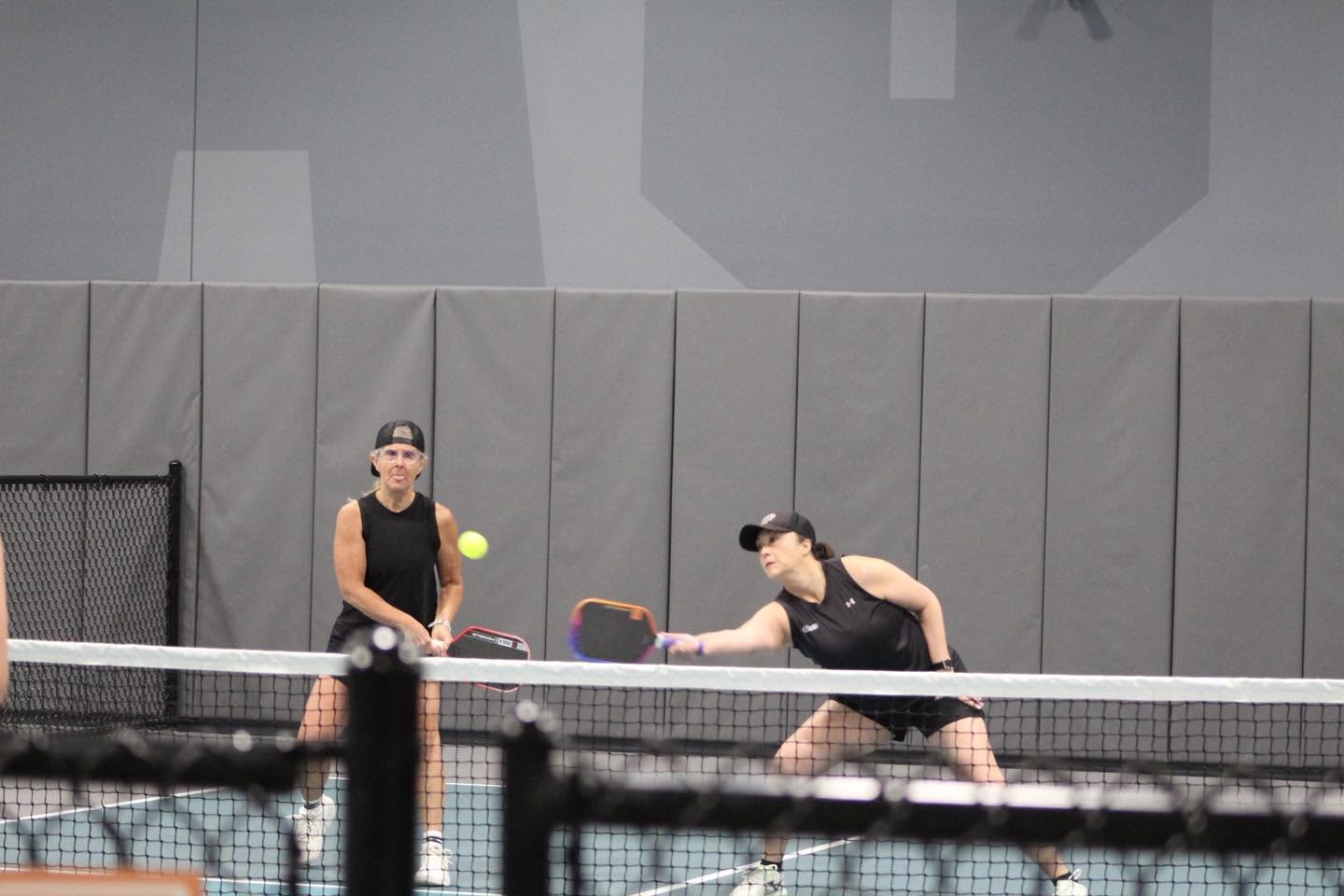
The Kitchen is a Utah-based pickleball franchise quickly spreading through the state. Their facility designs are smaller and more intimate, but their impact on the Utah pickleball scene has been significant. The owners of the Kitchen save loads of their time and energy by installing small, self-running facilities that require little to no employee maintenance. Efficient, low-maintenance facilities are the key to the Kitchen’s unique business model.
Britton Black’s parents introduced him to pickleball seven years ago, and he says, “I just immediately fell in love with the game.” Britton’s wife, Jamie, found a love for pickleball soon after, so the two decided to open up a small facility in Woods Cross, Utah with Britton’s father. One year later, they opened up their second facility in Kaysville, Utah.
The Kitchen at Woods Cross is a three-court, temperature-controlled facility complete with a hangout area, bathrooms, and vending machines. The Kaysville location is neat and intimate with five quality courts, a central hangout center, and two elevated observation decks. The Kitchen at Roy, Utah is the newest and largest installation with 8 indoor courts and 2 hangout areas. Besides these three facilities, the folks at the Kitchen anticipate opening up two new locations in the near future in Pleasant View and Mountain Green. Every facility affiliated with the Kitchen is open 24/7.

One of the Kitchen’s primary focuses is providing a welcoming, intimate environment for new players to be introduced to the game. Black says, “We want to provide a very welcoming place to play pickleball all year long with perfect conditions in an indoor setting. Our whole goal is to make it a little more intimate and less intimidating.” One way that the folks at the Kitchen make their clubs less intimidating is by keeping their facilities small. They believe that smaller buildings help people feel more cared for and safe: “We love a smaller more intimate setting. We don’t plan on doing any big, massive facilities.”
The Kitchen business model centers around small facilities that don’t require employees to be on-site: “Our system and all of our training and teaching are where you can run your facility with really almost zero employees. It’s a simple, profit-focussed model that doesn’t have a very large overhead.”
The Kitchen’s employee-free system was motivated by the owner’s limited free time and past experience as a business owner. Black owns a security company with over 100 employees, and though he appreciates employees, he realizes the difficulty that comes with hiring and managing them. He says, “Employees are great, but one of the problems we do have is the difficulty with employees. When they’re bad, they cause a lot of problems.” The Kitchen’s employee-free model avoids these potential problems. The lack of employees on-site may also contribute to the Kitchen’s welcoming atmosphere: “People don’t want to have to deal with individuals at every turn.”
The Kitchen also does an excellent job with their programming: “We run a lot of leagues, clinics, and the best tournaments. When we do something, we do it really well.”
Youth programming is a central focus at the Kitchen. Hundreds of kids attend the youth programs which continue to grow every month. Black remarks that ladder leagues have been the most successful youth program at the Kitchen because kids usually prefer to “get out and play” rather than spend loads of time at clinics.
Pickleball at the Kitchen has served as a positive force in the lives of many local kids. Black comments, “Pickleball has saved so many kids. There are a lot of kids out there who are looking for something, something they can be passionate about.”
The folks at the Kitchen are excited about their recent growth and hope to continue growing in the future. They are talking with several potential new franchises in the Utah area as well as “discussions with dozens of people outside of the state.”
Black leaves with three pieces of advice. First, stay attuned to the changes going on in the wider pickleball world: “Focus on what the majority of what pickleball players want and build on that.” Second, be meticulous: “Pay attention to details.” Lastly, “Listen to your members and focus on them because they’re the lifeblood of a successful facility.”
The Kitchen proves that one doesn’t need massive, 20-court facilities to run a successful franchise.