Pickleball clubs looking to establish themselves as a premier club in their area often look to a pro shop to increase their imprint on the local community as well as increase their club’s revenue. Whether you’re a dedicated pickleball club or all-encompassing racquet club, a pro shop is a great way to bring customers into your facility and promote your club’s staff as knowledgeable pickleball enthusiasts. Below, we look at two unique clubs and how they run their pro shops.
At Proshot Pickleball in Egg Harbor Township, New Jersey, members have the privilege of having an in-house uniquely branded proshop to serve all their pickleball gear needs. Landing Creek Pickleball, which just opened their second location inside Proshot Pickleball, sells high caliber gear including everything from paddles and grips to protective eyewear and pro shop branded apparel. In addition to their original brick-and-mortar location inside Pessano’s Variety Store in Ocean City, New Jersey, Landing Creek has an online store where pickleballers across the country can shop their curated gear.
Prior to being in the pickleball industry, Andy Pessano, a co-owner and founder of Proshot and owner and founder of Landing Creek, was in the seasonal retail industry, focusing on beach retail stores in the Ocean City area. In transitioning into the indoor pickleball facility arena, Pessano “saw continued growth in pickleball through retail,” hence why it was so important for his indoor pickleball facility to have its own pro shop from the beginning.

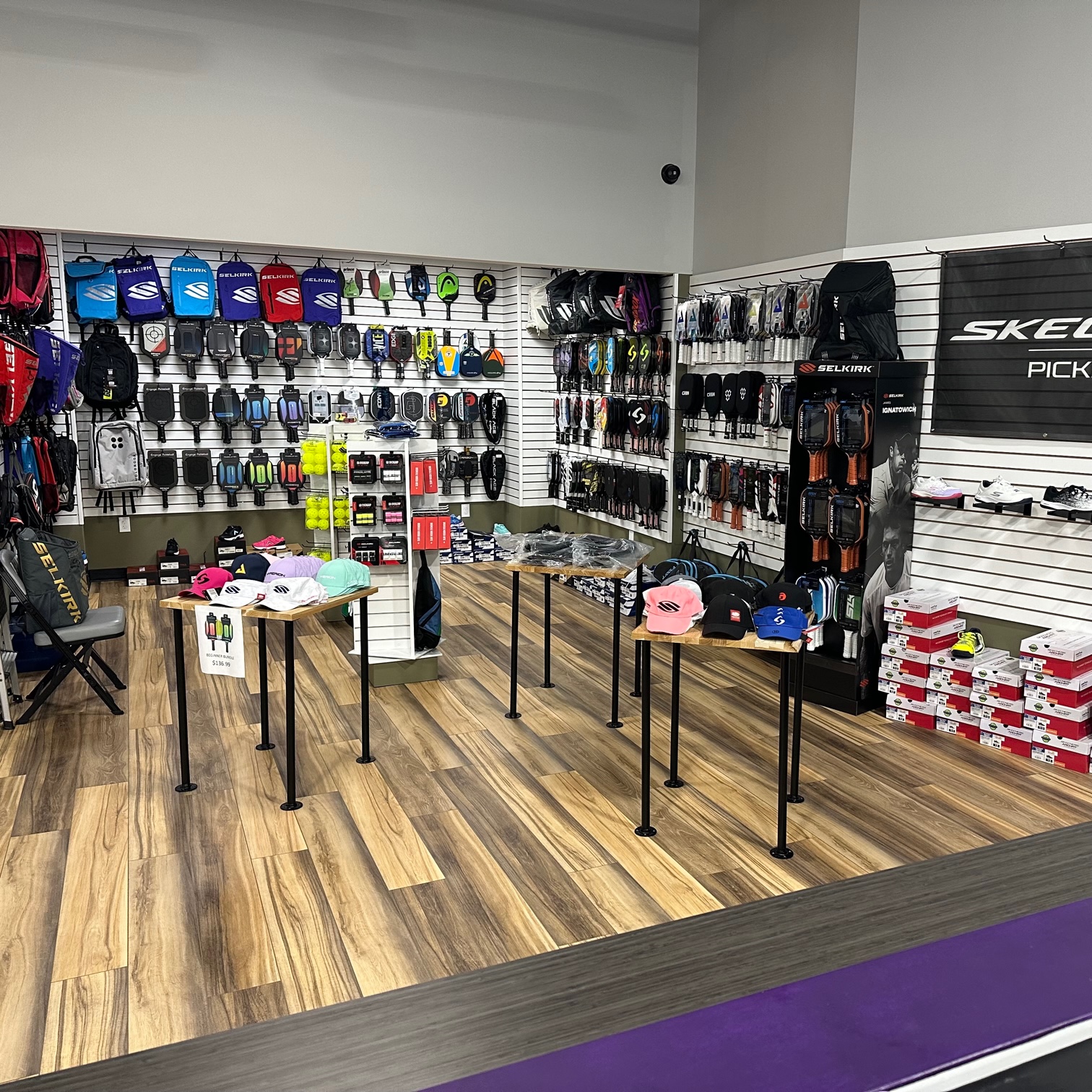
Landing Creek features 15 different brands of paddles and 100s of paddle styles and has several exclusive agreements with paddle companies. Additionally, the pro shop has an exclusive shoe agreement with Sketchers so they are the primary retail option for purchasing Sketchers shoes in the area. In terms of gear, Landing Creek has everything a player could need such as grips, balls, paddle covers, and other accessories. While they do have pro shop branded apparel, Pessano has stayed away from licensed apparel in recent years as he has learned the “vast majority of players are not really familiar with brands” and tend to not care if their paddle brand matches their apparel. During the time Landing Creek did feature licensed apparel, Pessano found that customers were not responding to it and that it took up too much space to justify having it in store.
As the sole buyer for Landing Creek, Pessano thoughtfully chooses each item he brings into the pro shop. Of course, he “[looks] at margin and what kind of offers [the companies] have” for wholesale deals but Pessano is also paying attention to feedback from members and listening to what customers are saying about brands and gear. When it comes to selecting paddles for Landing Creek, Pessano likes to see whether the paddles are on the pro tour and if professional players are using them. Right now, Pessano is seeing a lot of demand for raw carbon paddles and tends to see specifically second and third time paddle-purchasers looking for a raw carbon paddle.
Maintaining the right amount of inventory of the right equipment can be quite a challenge for a pro shop as the market and trends are constantly shifting. Pessano comments that the “retail paddle industry is like the wild west right now” with so many different brands and styles of paddles. Further, the main brands are often changing things with their paddles and customers are often looking for the latest and greatest. For example, if a manufacturer changes the color of a paddle, players naturally want the new color, making the older models of the paddle almost obsolete. As a retailer, it is difficult to turn product over efficiently because the trends are changing even quarterly. For these reasons, Pessano is not afraid to intentionally run out of a certain item in order to not overbuy inventory that he will not be able to sell once that particular style or trend has died down. One of the things a pickleball retailer must be able to do is see what is coming down the pipeline to protect themselves from having excess product that no one wants. At the same time, it is a challenge to “keep hot products in stock” so you “have to keep on top of things.”
In addition to the innate customer base of members from its home pickleball club Proshot, Landing Creek benefits from its partnership with the Pickleball Club by sharing staff. Landing Creek uses Shopify with handheld POS machines so a customer can pick out items from the pro shop and any Proshot staff member with POS equipment can handle the transaction. Therefore, the pro shop does not require additional staffing levels for the club. Moreover, the two entities are able to do cross promotional marketing and share in their marketing resources.
With many years of experience in the retail industry, Pessano has a keen eye for how to be successful in the world of pickleball retail. One of his biggest pieces of advice is that you “have to be careful not to get caught up in the hype.” With the paddle market, specifically, changing temperament so frequently, it is imperative that as a retailer, you don’t buy into the hype of each new paddle so you don’t wind up with quickly antiquated overstock. Pessano is hopeful that in the next five years the cream of the crop in terms of pickleball brands will rise to the top, leaving only 30 or so brands to compete for the retail space, as opposed to the 300+ currently in the industry, making pickleball retail slightly less cluttered.
Over at Frog Hollow Racquet Club in Lansdale, Pennsylvania, their pro shop comprises gear for both pickleball and to accomodate all of their members. Harold Conway, Frog Hollow’s Owner-Partner, feels the pro shop “is an add value to the organization and to clients” as they are able to serve their members by providing high quality gear right at their home club. Frog Hollow’s specialty pro shop has been open since the club’s opening and offers racquets, shoes, logo clothing, and bags for both sports. This pro shop works with some of the top retailers, such as Head, Wilson, and Babolat, and receives new merchandise on a quarterly basis.

The pro shop at Frog Hollow is truly a team effort. They operate with the mindset that “the entire staff [is] a part of [their] sales force so input from [everyone goes] into” purchasing new merchandise. When selecting merchandise, the two factors they most heavily consider are the “latest trends and cost affordability for clients.” Further, based on the pro shop’s volume and traffic, they have two people to be the ideal staffing level.
To capitalize on the holiday season, the Frog Hollow Pro Shop holds an annual holiday sale. Moreover, they will have irregular sales based on merchandise line changes to keep their inventory fresh.
As far as marketing goes, Frog Hollow uses “flyers and social media push notifications to [their] membership” to let members know about new items, upcoming sales, and other relevant information about the pro shop. Within the pro shop itself, staffers wear logo performance wear for the specific brands they have personal agreements with to help promote those brands.
Conway strives to make the Frog Hollow Pro Shop a “fun and social place for players to look [at] and test out new gear and play with the latest models.”