


From One Facility to Many: Rethinking How Pickleball Facilities Operate at Scale
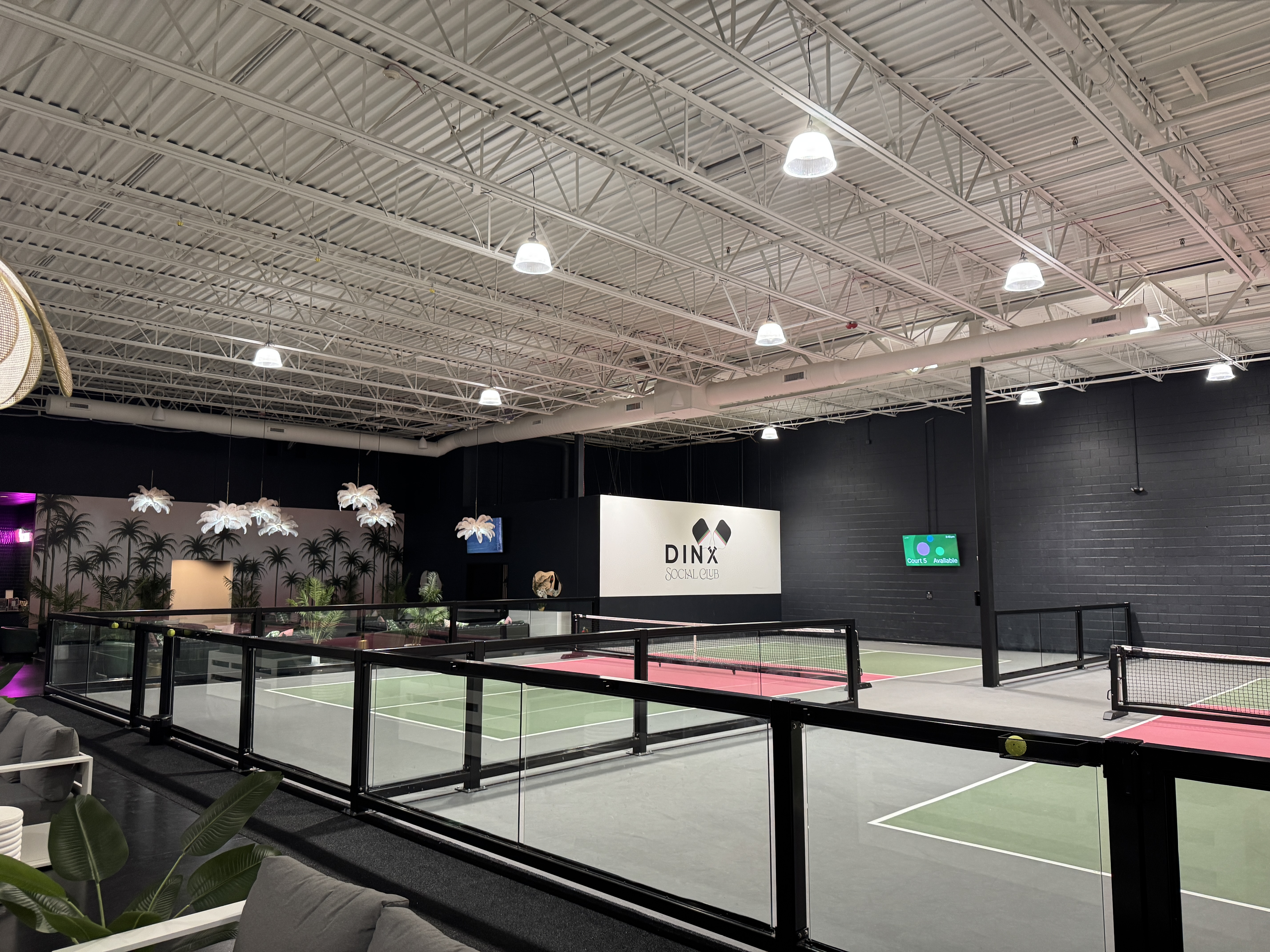
When David Sloane opened DINX Social Club in Highland Park, Illinois, he knew he had a winning concept. The courts were pristine, the lounge was inviting, and the community was eager to play. But like many new facility owners, he quickly ran into a challenge he hadn’t fully anticipated—the building itself.
“Dave offered me an opportunity to realize some savings, which is always helpful when you’re launching a new business,” Sloane recalls. “Our utility costs in the summertime when you’re running AC get high, and in the wintertime when you’re running gas heat, very high as well.”
It’s a familiar experience across the industry. As pickleball facilities expand rapidly—often in repurposed retail or industrial spaces—operators are inheriting systems that were never designed for the dynamic demands of a modern sports facility.
The building works—but it doesn’t perform the way they expected it to.
A common question starts to surface:
“Our utility costs are higher than expected—what can we do?”
That question is rarely tied to a single issue—it’s usually the result of decisions made long before opening day, reflecting how the building was evaluated, designed, and prepared to operate from the start.
Site Acquisition: Understanding What You’re Inheriting
Most pickleball facilities today are developed in existing buildings. While this approach can reduce construction timelines and upfront costs, it also means operators inherit mechanical and electrical systems that were never designed for this type of use.
Developing a consistent process for evaluating HVAC systems during site selection can provide significant long-term value. In many ways, it’s similar to hiring a professional home inspector before purchasing a home—identifying potential issues early, before they become costly surprises later.
One of the most common challenges during site selection isn’t a lack of effort—it’s competing priorities. Owners are often focused on securing the right location and lease structure to bring their vision to life, which is critical. But without a clear lens on the existing infrastructure, those early decisions can create ripple effects that carry through construction and into long-term operations.
In many projects, responsibility for evaluating systems is shared across architects, contractors, and project teams. While each plays an important role, this can sometimes lead to gaps in how the building is ultimately set up to perform once it’s in use.
At the same time, nearly every operator recognizes that building a strong, identifiable community is essential to success. But the physical environment plays a direct role in supporting that experience. When infrastructure isn’t aligned with how the facility will actually operate, it often becomes more complex—and more costly—to adjust later.
For new owners especially, early-stage capital is heavily focused on opening the doors. Investing a relatively small portion of that budget into understanding and optimizing systems can feel secondary in the moment—but it often delivers one of the fastest returns once the facility is operational.
Reviewing recent occupied utility bills can offer an initial benchmark. From there, a deeper look at HVAC systems becomes essential. Many rooftop units (RTUs) are already well into their service life. Units over 15 years old may still function, but their performance and efficiency can vary significantly.
Even when systems appear operational, configuration issues can quietly impact performance. I’ve walked into facilities where the thermostat clock was off by several hours—cooling the building at 3:00 a.m. and shutting down just as players started arriving in the evening. No one realized it was happening because many systems are simply set—and forgotten.
Another issue I see more often than you’d expect is improper wiring—where first- and second-stage cooling are configured to operate at the same time. The system continues to run, but efficiency drops, energy use increases, and equipment wear accelerates—often without the operator realizing anything is wrong.
Then there are the manual overrides. Put a thermostat in a public space, and someone is going to adjust it. And when they do, they rarely move it a couple of degrees—they push it all the way. That unit then runs continuously until someone notices.
Understanding warranty status, replacement responsibility, and acceptable downtime is equally important. Equipment failures don’t just carry repair costs—they impact player experience and revenue.
Energy procurement (supply-side strategy) should also be considered early. In deregulated markets, supply contracts vary widely in structure and risk. Fixed-rate agreements offer predictability, while pass-through structures introduce market exposure. Contract duration and renewal timing must be actively managed—expired agreements can default to significantly higher rates.
Lease structure can further influence cost exposure. In some cases, operators can negotiate utility terms into the lease, shifting certain risks while focusing more directly on demand-side performance.
At this stage, the goal is not to solve everything—but to understand how the facility will perform over time.
Development: Building the Foundation for Performance
During construction, many decisions unintentionally lock in future inefficiencies. HVAC systems are often left running under default settings or manual overrides during buildout. It’s not uncommon for systems to run continuously—cooling or dehumidifying far beyond what’s needed—often resulting in elevated costs before the facility even opens.
Humidity control plays a key role during court surfacing, but requires intentional management. Without oversight, systems are frequently left running around the clock.
Lighting represents a major opportunity—not just in fixture selection, but in how it’s controlled. Circuiting, zoning, and advanced control systems allow lighting to adapt to actual usage. Networked lighting platforms, fixture-level control, and integrated sensors enable dynamic response based on occupancy and scheduling.
Even modest dimming strategies can reduce energy use while remaining largely unnoticeable to players.
Advances in sensor technology further enhance this flexibility. Motion, temperature, and humidity sensors allow facilities to shift into standby modes when unoccupied, while still enabling rapid recovery when activity resumes.

Commissioning is another critical step. In practice, wiring and configuration issues are not uncommon and can affect a meaningful percentage of installations. These issues may seem minor, but they can increase energy use, reduce comfort, and place additional strain on equipment—ultimately shortening system lifespan.
An independent commissioning process helps ensure systems are not just operational, but performing as intended from day one. The decisions made during construction don’t just impact opening—they determine how effectively the facility will operate for years to come.
Operations: From Static Systems to Dynamic Performance
Once facilities are operational, inefficiencies become more visible. Systems run when they don’t need to. Comfort varies. Costs rise. Adjustments are made reactively—rather than proactively.
The root issue isn’t the equipment—it’s alignment.
Most facilities still operate on static schedules, while usage patterns are dynamic. Court activity fluctuates, yet systems continue to run as if demand were constant.
A new approach is emerging. Advanced optimization platforms continuously analyze system performance and adjust operation in real time—based on temperature, outdoor conditions, schedules, and usage patterns.
The result is a system that operates more intelligently—reducing unnecessary runtime while maintaining comfort. In practice, facilities that implement this approach often see 10 to 15 percent reductions in annual energy use—sometimes more—without replacing major equipment.
These platforms also provide visibility into system behavior—helping identify issues before failure. In many cases, the system hasn’t failed—it’s just been running inefficiently for weeks without anyone realizing it. Because the real cost of failure isn’t just repair—it’s disruption to the player experience. A cooling issue during a tournament weekend can directly impact revenue and customer experience.
As operators scale, management approaches evolve as well. Managing one facility manually is manageable. Managing five that way isn’t. Control shifts from manual adjustments to centralized visibility through web-based dashboards to monitor performance across multiple locations. This enables “management by exception,” where attention is focused only on systems operating outside normal conditions.

Schedules can be adjusted remotely, avoiding unnecessary energy use during unexpected closures—such as weather events—without requiring onsite intervention.
Benchmarking: The Line Judge of Facility Operations
As individual pickleball players, we’re all familiar with the concept of ranking—constantly working to improve and understand where we stand relative to others.
A similar question is starting to emerge at the facility level:
How do we know if a facility is truly performing well?
Unlike player rankings, there is no universal standard today that defines operational performance. However, benchmarking provides a starting point. By normalizing energy use against key variables—such as square footage, number of courts, and operating characteristics—facilities can begin to establish meaningful comparisons.
In many ways, this functions like a line judge in a match—providing an objective reference point rather than relying on perception alone.
For multi-location operators, benchmarking introduces transparency and alignment. High-performing facilities can inform best practices, while underperforming locations can be identified and improved more quickly.
Case Study: DINX Social Club (Highland Park, IL)
At DINX Social Club in Highland Park, Illinois, seven connected thermostats were installed in May 2025, enabling demand-driven HVAC optimization across the facility.

Like many facilities, DINX inherited an existing HVAC system that wasn’t originally designed for a high-activity indoor sports environment. While a full system replacement wasn’t feasible, targeted adjustments to system configuration—combined with an added layer of intelligent control—allowed the facility to significantly improve overall performance.
As the system approaches one year of operation, the results have been measurable. The facility has achieved reductions in peak demand, electricity usage, and gas consumption—while maintaining a consistent and comfortable playing environment. For a facility consuming roughly 180,000 kWh annually, the 8% reduction in electric usage alone represents more than 14,000 kWh of savings each year.
When combined with improved energy procurement strategies, the total impact is approximately equivalent to one month of utility costs.
The impact goes beyond energy savings. Operators also gain greater visibility and control over how the facility performs day to day—shifting from reactive adjustments to a more proactive approach to managing comfort and system performance.
“All through the winter, we’ve never had to tell our members to bring a jacket because it was too cold on the courts,” says David Sloane, Founder of DINX Social Club. “Maintaining a consistent playing environment has been just as important as reducing energy costs.”
This combination of operational efficiency and supply-side energy strategy reflects a broader approach to reducing total cost of ownership while improving the overall player experience.
Industry Adoption: Diadem Pickleball Complex (Florida)
Diadem Pickleball Complex (DPC) is taking a proactive approach to energy management and player environment as it grows its presence across Florida. Operating as an independent brand with a mix of company-owned and franchised locations, DPC is also entering select markets through strategic partnerships—such as its collaboration with Elev8 Fun at the Jensen Beach location.

As the organization scales, maintaining consistency across locations becomes increasingly important. This includes not only the player experience, but how each facility operates from both a operational and energy standpoint.
DPC is also highly focused on securing long-term real estate positions that set each facility up for sustained success. That long-term perspective naturally extends to how systems are designed, operated, and managed over time.
Just as important is the culture behind the brand. With a team of long-tenured employees and a strong, community-driven approach, DPC has built an environment centered around consistency and connection—what they often describe as “positive vibes only.” That culture reinforces the importance of delivering a reliable, comfortable, and welcoming experience across every location. It also underscores how operational consistency and player experience are closely connected.
Integrating system performance, energy management, and centralized visibility across both new and existing locations reflects a natural extension of DPC’s established operating model and community-focused approach.
More broadly, this reflects a shift across the industry—where leading operators are beginning to view energy performance and system control as part of the overall facility experience, not just a back-of-house function.
Looking Forward: Operating as a System
As facilities scale, the challenge shifts from individual decisions to coordinated operations. Demand-driven control aligns systems with usage (demand-side), while energy procurement strategies help manage cost exposure (supply-side). Asset intelligence provides visibility into equipment performance. Capital strategies enable upgrades through financing and incentives.
Together, these elements create a unified operating model—reducing total cost of ownership while improving consistency and performance across facilities.
The next phase of growth will not be defined by how many facilities are built—but by how effectively they are operated. At its core, a pickleball facility isn’t just a building—it’s a coordinated environment where design, systems, and operations align to shape both the player experience and long-term financial performance.
As multi-location ownership continues to grow, operators who treat their facilities as connected environments—rather than independent buildings—will have a clear advantage in both cost control and consistency.
Closing Thought
For operators navigating new developments or optimizing existing facilities, a coordinated approach across performance, systems, and cost can make a meaningful difference.
The facilities that perform best won’t just be the ones that are built well—but the ones that are operated with intention over time.
These conversations are becoming increasingly important across the industry. Engaging early makes all the difference—because every month of delay is money left on the table.
Author Bio
David Anderson is the Founder of Energie Consulting & Controls and Energie Multisport, where he helps pickleball and multisport facilities improve performance through smarter HVAC, lighting, and energy strategies. With more than 30 years of experience in building automation, he works with operators to reduce operating costs, enhance player comfort, and create scalable, efficient facility operations.
David Anderson
Founder, Energie Multisport
www.energiemultisport.com
Specializing in optimizing HVAC, lighting, and energy performance for multi-location sports and recreation facilities.


2 thoughts on “From One Facility to Many: Rethinking How Pickleball Facilities Operate at Scale”