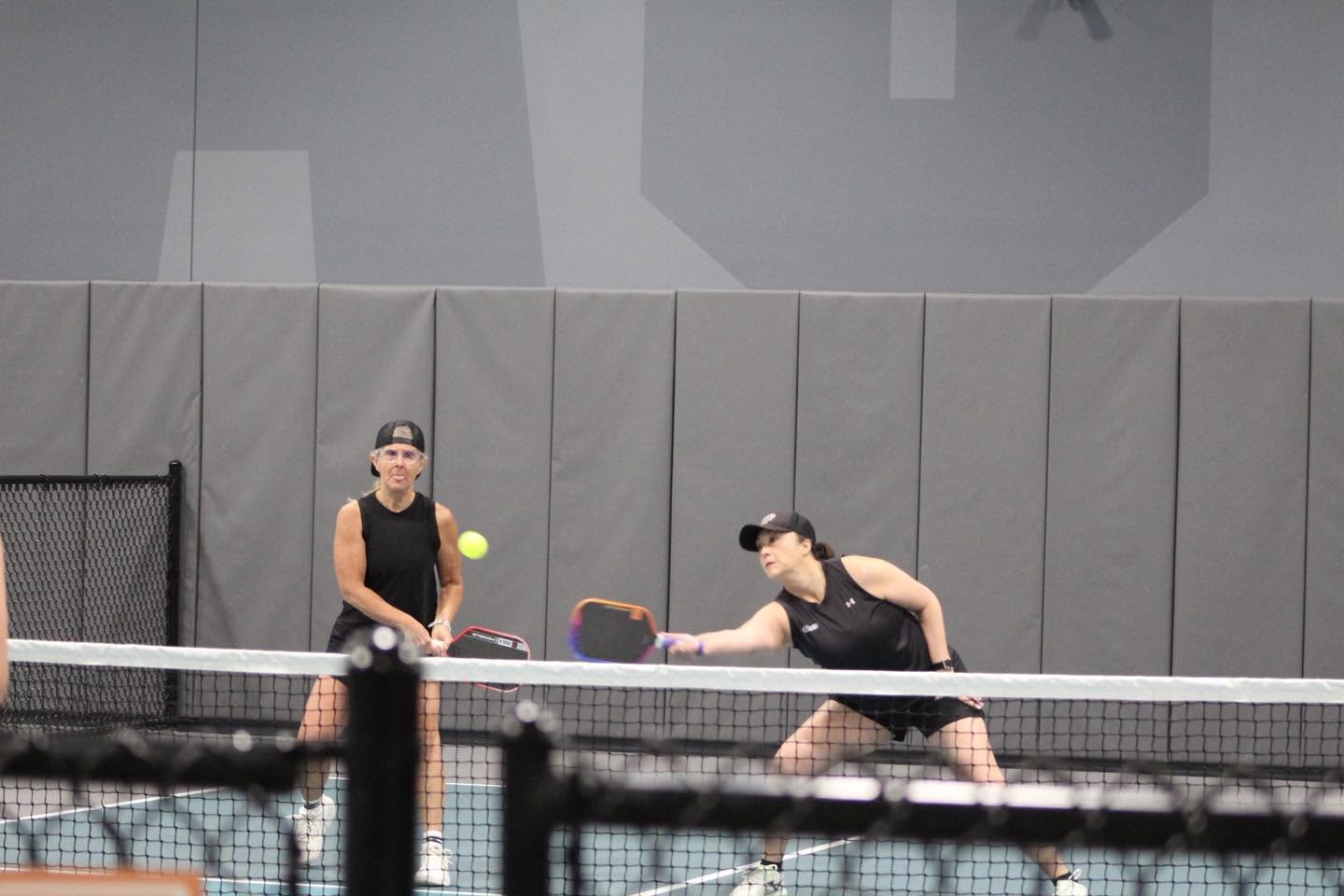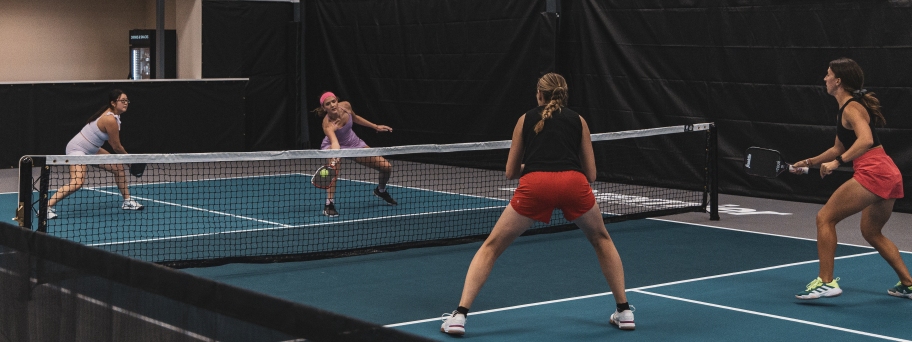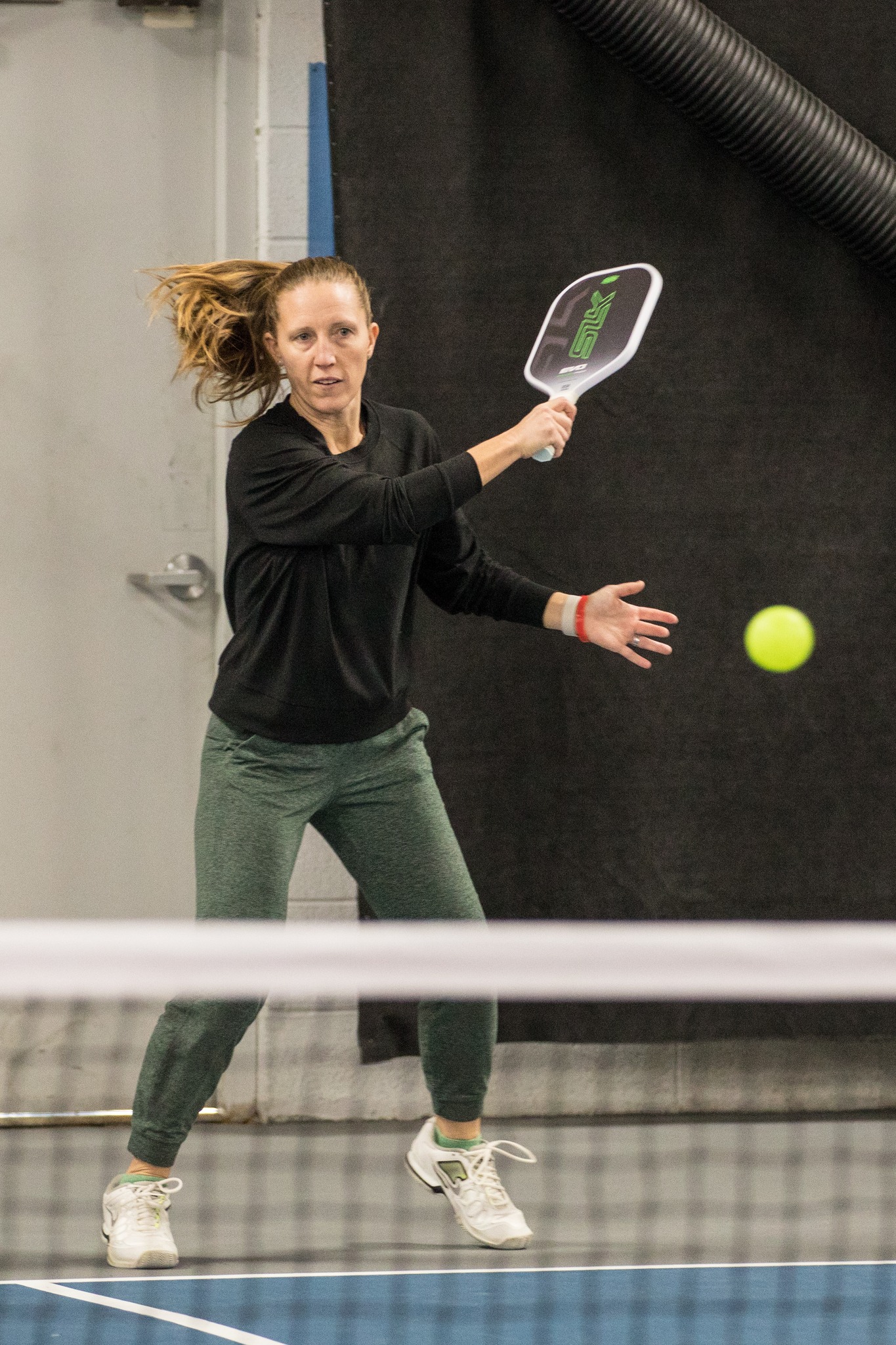
What do you call four guys who play pickleball weekly and were “30% serious” about opening a pickleball club? The owners of Rally Pickleball Club in Auburn, Washington.
Co-owner and general manager Dillon Eugenio says one off-handed comment, a lot of number-crunching, and a dream led to the opening of the 14 indoor-court facility in July of 2025.
“We joke that we sound like the start of a bad joke – a plumber, a dentist, an electrician and a medical salesperson walk into a pickleball club,” Dillon says. “But it has worked out perfectly thanks to our blend of business experience and a shared vision for a facility that puts players and their experience first while still being profitable.”
A Facility Built for Players First
To help make the idea a reality, the owners found a facility with 28-foot ceilings along with the perfect width and depth that created the perfect margins for 14 pickleball courts. During construction, they made a conscious decision to invest in premium court surfaces, top-tier lighting, and spacing between courts that allowed for comfortable play. Dillon says they knew these were items they couldn’t go back later and change; however, amenities can always be upgraded.
Those early build decisions echo the fundamentals other operators weigh when they open a successful pickleball facility. Getting the non-negotiables right the first time, especially proper court lighting, is far cheaper than retrofitting later.
“We wanted to create a place people wanted to be or a community hub people looked forward to coming to, not just a money machine,” says Dillon. “We really thought about what we can do to make the best part of our members’ day last longer; and we designed our amenities with that in mind.”
Amenities Designed Around Member Experience
Rally’s amenities are built to give members a reason to stay, socialize, and come back. The club offers:
- Multiple lounge spaces, including a large lounge with TVs for watching sports and other events
- Bleachers that overlook a challenge court area during open play
- Six cabanas with couches and swiveling armchairs, available for rent or on a first-come, first-serve basis
- Golf simulators so members can stay on top of their swings between games
It’s a philosophy that reflects a growing industry truth: pickleball needs more than just courts and paddles to build lasting loyalty.
Dwell Time: The Metric That Proves Community
One of Rally’s key performance indicators is player dwell time at the club. Dillon says a typical match lasts two hours and their average dwell time is two hours and 45 minutes.
“This shows us people are coming and then choosing to stay and hang out with friends. We hoped to build a community at Rally and it seems to be working!”
- Typical match length = 2 hours 0 minutes
- Average member dwell time = 2 hours 45 minutes
- Extra time spent at the club = 45 minutes (37% longer)
That dwell time is more than a feel-good number, it’s a revenue signal. When members linger, they buy more and engage more, a dynamic explored in turning player time into revenue. Rally’s community-first approach mirrors clubs like Cedar Falls Pickleball Club and City Walk Pickleball in Birmingham, where connection keeps members coming back.
A Membership Model Focused on Court Availability
With an eye on player satisfaction, Rally aims for 650-700 members total to allow for court availability. While many clubs base their profit model on 100 players per court, Rally realizes many of their members play six or seven days a week and wants to keep meeting those expectations of open court time.
- Target membership: 650–700 members across 14 courts
- Industry norm: roughly 100 players per court
- Rally’s priority: protecting open court time for members who play 6–7 days a week
Adapting to Seasonality
Like many clubs, seasonality affects court bookings. In Washington, many players try to grab as much outdoor time as possible during the summer after long, dark winters. Rally meets their players needs by being versatile and continuing to keep an eye on player needs and likes.

“We adjusted our leagues and are trying new things to keep players indoors, which can be challenging with so many free outdoor courts,” Dillon says. “The club offers golf simulators so members can stay on top of their swings in between games. We also focus on our Rally community as it’s hard to create what we have here on disjointed, public outdoor courts.”
Managing those seasonal swings is a challenge every operator faces — and one that savvy clubs turn into opportunity, as covered in weatherproofing pickleball’s future.
Dillon adds they also host charity tournaments during summer including their upcoming Wooden Paddle Battle benefitting the local Wounded Warrior Project. “As a veteran owned company, we want to represent our values and give back to the community. All tournaments we hold benefit local non-profits which is something that we take great pride in,” says Dillon.
Smart, Low-Overhead Revenue Without a Kitchen
As a smaller club focused only on pickleball, Rally decided to forego a restaurant or food-service options. Adding a restaurant or food prep is costly and not necessary they’ve found as players are happy to bring their own food or have items delivered. Rally does understand people get hungry and thirsty though and have meet their needs while also keeping on eye on profit margins.
The club invested in smart refrigerated vending machine they stock with items including Lunchables and Uncrustable PB&J sandwiches. It requires very little interaction by owners since members put in a credit card and it scans anything taken out of the window. In two months, the club has paid off their initial investment.
Rally’s food-and-beverage strategy stays lean and profitable:
- Smart refrigerated vending stocked with Lunchables and Uncrustable PB&J sandwiches — paid off in just two months
- Additional machines for electrolyte drinks, pop, and chips
- Coming soon: a heated-items machine for Hot Pockets and convection-oven snacks
- On the horizon: a soon-to-be-approved liquor license for small, select-time service
Rally has additional vending machines stocked with electrolyte drinks and pop and another with chips etc. They have found such success with the smart vending machines they are looking into one with heated items like Hot Pockets and other items that can be made in a convection oven. The vending machines allow members to enjoy snacks without any clean-up, need for a kitchen or additional staffing and the club continues to make a profit. The club is close to a being approved for a liquor license, and Dillon notes the service will be small and during very select times.
Lean Staffing Built on Community Trust
Rally has a lean staff with two full time employees, including Dillon who took a sabbatical from his full-time position, and another manager mixed in with part time staff.
“Thanks to the great community and level of trust we’ve grown, we are able to allow members to come in before normal operating hours without any problems.” Dillon adds they are looking to expand into evening hours as well to fit member needs.
Built to Grow: Leadership Beyond the Startup Phase
Operating as a privately held company vs. a chain allows for flexibility with staffing as the business changes and grows. Skill sets that suit a business in the beginning stages such as executing orders and following plans might fall to the wayside as a company grows and needs more organizational and leadership skills.
As a business owner, Dillon has experienced first-hand company founders are rarely the people who end up running the business. “It’s important to have outside eyes looking in to ensure a mentality that worked when opening the business doesn’t hold you back when trying to grow the business.”
Keeping pickleball and members first has proven to be a successful strategy for Rally Pickleball Club. They show the most successful facilities might not be the biggest with the most amenities; they are the ones people feel connection, known and look forward to returning to day in and day out.

Frequently Asked Questions
Where is Rally Pickleball Club located?
Rally Pickleball Club is a 14-court indoor facility in Auburn, Washington, that opened in July 2025.
What is dwell time and why does it matter for pickleball clubs?
Dwell time is how long members stay at the club beyond their actual play. At Rally, average dwell time is 2 hours 45 minutes versus a 2-hour match — a sign that members treat the club as a community hub, which supports retention and ancillary revenue.
How does Rally Pickleball Club make money without a restaurant?
Rally uses smart refrigerated vending machines for food and drinks, keeping overhead low. The initial vending investment paid for itself in two months, and the club is adding heated-food options and a limited liquor license.
Read the Latest Issue of Pickleball Club Magazine
Want more stories like Rally’s — the strategies, data, and operators shaping the business of pickleball? Read the latest issue of Pickleball Club Magazine here, and subscribe to our newsletter so the next issue lands straight in your inbox.