


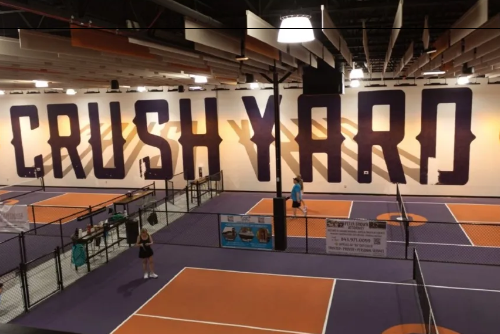
In an increasingly crowded field of pickleball entertainment concepts, one facility is quickly emerging as a category leader, not by replicating what’s already out there, but by reimagining what pickleball facilities can be. Founded by CEO David Hack, Crush Yard is setting a bold new standard for how pickleball and social experiences can intersect under one roof.
The Flagship: 40,000 Square Feet of Courts, Kitchen, and Clubhouse
With its first flagship location in Mount Pleasant, South Carolina, just outside of Charleston, Crush Yard has gained fast traction not only among players but also among investors, celebrities, and franchisees. The facility features:
- A 40,000-square-foot footprint with eight indoor pickleball courts
- A full-service kitchen with everything made from scratch by executive chefs
- A curated 40-tap self-pour beer wall
- An upscale sports-bar-meets-clubhouse vibe
- A steady lineup of events designed to draw everyone from families to elite players
“It’s not just a pickleball place,” says Hack. “It’s a hospitality concept first.” Read more about Crush Yard in the May/June issue.

“Topgolf for Pickleball”: Why Hospitality Leads the Business Model
Unlike many emerging pickleball clubs that center solely on court rentals or competitive play, Crush Yard puts equal if not greater emphasis on food, beverage, and the broader social experience.
“The simple explanation is we are Topgolf for pickleball,” Hack says. “We want people who don’t even play to walk in and still have a great time.”
That positioning is deliberate. Hack’s market math targets the widest possible audience:
- 90% of the pickleball space is regular people who want to hang out and play a little pickleball
- The hardcore players account for about 10% of the market share
“I think we want to appeal to the 90%, but obviously have the 10% feel like this is also a home for them as well,” Hack explains. “It’s about giving people multiple reasons to visit, not just one. Pickleball is the anchor, but food, drink, music, events are the repeat drivers.”
The approach is working. Mount Pleasant’s location has exceeded expectations across key metrics, from year-over-year revenue to seasonal swings. Read more in the May/June issue.
The Brand-First Strategy: Lessons from the Hotel Industry
Hack’s vision is informed not just by trends, but by deep analysis of what makes experiential hospitality brands successful.
“If you look at hotels in the 1950s, they owned 99% of the real estate. Today, those same big brands own less than 1% of the real estate. The value is in the brand,” Hack says. “So we brought on large media companies, so those guys are now investors and partners with us, because we’re about driving the brand moving forward. If you look at this industry, a $5 billion space by 2033, it is very fractured right now. We see a clear path for us to be the definitive leader.”

To execute, Hack brought on seasoned executives from hospitality, operations, and sports marketing. Together, the team designed a space that is modular and flexible, able to host tournaments, live music nights, kids’ birthday parties, and even weddings.
Site Selection and Facility Design: A Playbook for Operators
The guest journey begins before anyone walks through the door. Crush Yard approaches site selection with surgical precision:
- High-density, high-income suburban areas with strong retail adjacencies
- Buildings between 35,000 and 45,000 square feet
- High ceilings and enough parking to accommodate peak traffic
- Visibility from major roads is a plus, but the interior build-out does the heavy lifting
Events round out the model. Crush Yard regularly hosts beginner clinics, themed leagues, pro exhibitions, and community fundraisers, all curated with the same hospitality-first mindset. Music, lighting, food, and ambiance are all part of the equation.
Culture of Ownership: How Crush Yard Operates
Operations are built around a problem-solving mindset. “We kind of figure out where the problems are, and then bring people in to figure out the solutions,” says Hack. Once a team member is in place, the responsibility to resolve those issues becomes theirs.
“We’re handing the ball off, they gotta run with it,” he explains. “We don’t have the opportunity to babysit, and we don’t have the luxury of time. I try to give people an overall vision and keep the team excited about the opportunity.”

Hack’s Advice for Pickleball Club Owners
Hack offers pointed advice for current and aspiring pickleball club owners, grounded in both firsthand experience and industry insight.
1. Steer clear of the club-based or membership-only model. “The math doesn’t work,” he says plainly, citing both personal analysis and conversations with insiders who have left those models behind. Hack emphasizes that these setups often place operators at the mercy of landlords, stripping them of the freedom that entrepreneurship is meant to offer.
2. Do your due diligence on the competitive landscape. “Look at what brands are out there, who’s doing what,” he advises. Hack suggests that thorough analysis often leads to the same conclusion: sustainable models are rooted in diversified revenue streams, brand clarity, and operational control, not in rigid, outdated frameworks.
3. Think like a host, not a landlord. “A lot of people are jumping into this space with minimal experience in hospitality,” he says. “They’re thinking like landlords or gym operators. We’re thinking like hosts.” As more competitors enter the market, differentiation will depend not just on court count or square footage, but on quality of service, brand experience, and customer loyalty.
The Bigger Picture: First-Mover Advantage in a $5 Billion Space
Being first to space is a deliberate strategy grounded in timing and brand leadership. “Now is the time, now is the opportunity,” says Hack, citing both the rapid expansion of the pickleball market and long-term trends in the entertainment space.
Ultimately, Hack sees Crush Yard as more than a business. It’s a community-building engine. “Pickleball is inherently social,” he says. “Our job is to create a space where that social energy can thrive.”
For anyone in the business of running or developing pickleball clubs, the rise of Crush Yard offers a compelling case study: design for community, lead with hospitality, and scale with discipline.
For more on how operators are scaling beyond a single facility, read From One Facility to Many: Rethinking How Pickleball Facilities Operate at Scale and Lessons from SPORTIME Pickleball on Hiring and Developing Staff. Then subscribe to the Pickleball Club Magazine newsletter for the business side of pickleball, every issue.

FAQ: The Pickleball Entertainment Venue Model
What is a pickleball entertainment venue? A pickleball entertainment venue combines pickleball courts with restaurant-quality food and beverage, bars, music, and events under one roof. Unlike traditional clubs built around court rentals or memberships, the model treats pickleball as the anchor and hospitality as the repeat driver, appealing to casual visitors as well as dedicated players.
What is Crush Yard? Crush Yard is a pickleball, dining, and social concept founded by CEO David Hack, with its flagship in Mount Pleasant, South Carolina. The 40,000-square-foot facility includes eight indoor pickleball courts, a full-service scratch kitchen, a 40-tap self-pour beer wall, and a sports-bar-meets-clubhouse atmosphere. Hack describes it as “Topgolf for pickleball.”
How big is the pickleball entertainment market? Hack cites projections of a $5 billion space by 2033 and describes the current market as very fractured, which he sees as an opening for a definitive category leader with strong brand identity.
Why does Crush Yard’s founder advise against the membership-only club model? According to Hack, “the math doesn’t work.” He argues membership-only setups often leave operators dependent on landlords and locked into an unsustainable business model, while diversified revenue streams (courts plus food, beverage, and events) offer more control and long-term viability.
What should club owners look for in a pickleball facility site? Crush Yard’s criteria: high-density, high-income suburban areas with strong retail adjacencies, buildings between 35,000 and 45,000 square feet, high ceilings, ample parking for peak traffic, and ideally visibility from major roads.


One thought on “Crush Yard’s Bold Vision: Blending Pickleball, Dining, and Social Vibes”